Road trip!!!!!
Hey everyone, I have a new blog for anyone who is interested: The Massive Roadtrip
My fiance and I are leaving New York and moving out west, but we're doing a huge roadtrip on our way out there! Come with us via our blog!
Hey everyone, I have a new blog for anyone who is interested: The Massive Roadtrip
This is just a 7/2007 update on what's happening with me --

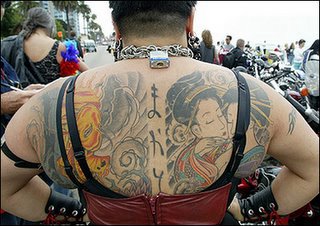
The US patent office has reversed position and approved a request to let a lesbian San Francisco motorcycle club trademark the name "Dykes on Bikes," the office confirmed.
"The original reaction of the examiner was to reject it because he considered the term (dykes) disparaging," Brigid Quinn of the US patent office told AFP.
"The applicant got lots of evidence, from everyone from lawyers to academics, that the term wasn't considered disparaging in the lesbian community."
An examiner approved the Dykes on Bikes trademark on December 5, Quinn said. After the decision is formally published, opponents will have 30 days to argue against finalizing the decision, according to Quinn.
Dykes on Bikes has led every Gay Pride Parade in San Francisco since the first procession some 30 years ago.

The possibilities for NEC's 'flattery' - as we like to call it - are endless. Smartcards have been touted as an obvious use, but it would fit in nicely with the idea of intelligent paper too. Before long, you might be rolling up your Powerpoint presentation and handing out your interactive business cards.
There are no official plans to use it in any products yet, but NEC has promised to 'carry out aggressive research and development' to enhance the performance and make it a commericial reality.
Bar/Bri & Kaplan have been sued under antitrust laws for having a secret agreement to stay out of each others markets so that they could overcharge for their product. Anyone who's ever taken Bar/Bri knows they paid far too much.
A complaint filed against BAR/BRI bar review and the West Publishing Corporation and Kaplan, Inc., in Los Angeles, claims more than 300,000 lawyers and law students were each charged an estimated $1,000 extra for bar review courses.
The April 29 lawsuit against the country's biggest bar exam and LSAT preparation companies, filed as a class-action lawsuit in the U.S. District Court for the Central District of California, alleges that BAR/BRI and test-preparation company Kaplan, Inc., agreed to illegally dividing the LSAT and bar exam test-preparation market.
The suit claims that under the alleged agreement, BAR/BRI withdrew from the LSAT preparation business and Kaplan agreed not to enter the bar-review course market. The complaint charges that "without substantial competition, BAR/BRI's net prices per student then increased substantially in most states." It claims that from 1997 to the present, Kaplan and BAR/BRI "have concealed their conspiracy to divide the market." The lawsuit claims BAR/BRI students were overcharged about $300 million since August 1997 and said customers may deserve $1,000 each in refunds.
"I do think it's curious that there's a single dominant provider nationwide," said Eric Goldman, a law professor at Marquette University Law School. "There's no indicia that the bar exam-preparation market is a natural monopoly, and most other test-prep areas have competition. So why is there only one dominant vendor in the bar exam-preparation area?"
...
"[BAR/BRI] seems to be the school-sanctioned choice, and I don't know anyone who has signed up for another method," said Oskin.
...
Rod Borlase is an attorney-mediator and said law students have been easy targets for exploitation because they often buy into the intense competitive nature of law school and of bar- and other prep courses.
"Practice aids throughout law school, particularly first year, then bar review courses after graduation—it's just one blood-sucking vulture after another," said Borlase. "On the other hand, I wouldn't want to take a bar exam without a review course, although I know some who have successfully."

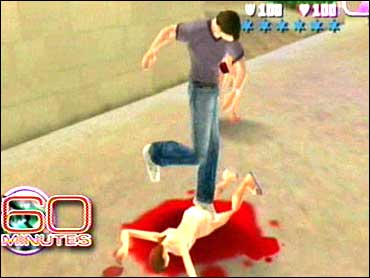
Senator Hillary Clinton and former vice presidential nominee Joseph Lieberman meanwhile launched new legislation intended to protect kids from graphic, violent and sexual material on their game consoles.Hillary Clinton targets new rise in video game violence
The National Institute on Media and the Family said in its annual report that video game retailors had failed to honor promises to safeguard children from violent and sexual content in new generation video games.
"There has been significant industry progress and reforms over the last decade, but ever more violent and sadistic games are still ending up in the hands of children," said the institute's president David Walsh.

NEWSPAPERS editors were threatened with prosecution under the Official Secrets Act last night if they published details of a conversation between Tony Blair and George Bush in which the President is alleged to have suggested bombing al-Jazeera, the Arab news network. Lord Goldsmith, the Attorney-General, informed newspapers editors including that of The Times that Âpublication of a document that has been unlawfully disclosed by a Crown servant could be in breach of Section 5 of the Official Secrets Act.Â
The Blair Government has obtained court injunctions against newspapers before but it has never prosecuted editors for publishing the contents of leaked documents.
Under a front-page headline ÂBush plot to bomb his ally in the Daily Mirror yesterday, a secret minute of the conversation in April 2004 records the President allegedly suggesting that he would like to bomb the channelÂs studios in Doha, capital of Qatar. Richard Wallace, the Editor of the Daily Mirror, said last night: ÂWe made No 10 fully aware of the intention to publish and were given Âno comment officially or unofficially. Suddenly 24 hours later we are threatened under Section 5.Â

We spotted this sign on Wooster near Canal Street, close to where all the vendors are selling bootleg Prada bags and illicit DVDs. The sign seems a little low-production value for the Motion Picture Association of America-- so we're curious who is behind it. Any ideas?Check it out here, thanks Gothamist.
The Supreme's are going to take a look at patent warehousing and when injunctions for infringement are appropriate. I'm not very knowledgeable about patent law, but I know there is lots of discussion among patent-types concerning how patents are being used offensively in an unfair manner -- some companies register patents soley to possess the rights to the technology and then sue companies that use similar technology. This is how I understand it: when a court decides an injunction against a potential infringer is warranted that infringer is essentially hostage to the claimant if the technology is necessary to their business model, leading to big payouts in cases where the infringement is not always clear.
The U.S. Supreme Court said on Monday that it would consider an appeal by online auctioneer eBay Inc. in a case that could determine when it is appropriate to grant an injunction against a patent infringer.
...
Experts said the case would give the Supreme Court a chance to define when an injunction should apply and comes as the patent community is debating to what extent patent holders who do not intend to practice their inventions should be allowed to extract profitable licenses from others.
...
The eBay case has attracted interest among those who believe it has become too easy to hold businesses hostage through patent suits.
A group of 35 patent law professors filed a friend of the court brief arguing that an entitlement to an injunction allows unscrupulous patent owners to threaten products that are predominantly noninfringing. A computer chip, they noted, may include 5,000 different inventions.
NewsDay.com article:
More than 6,800 candidates passed the state bar examination in July, the state Board of Law Examiners said Thursday.
Out of 10,171 candidates who took the test on July 26 and July 27, 6,805 passed. That's a 67 percent pass rate. The candidates who passed the exam still have to apply to the Appellate Division of the Supreme Court to be licensed to practice law.
New York, with 142,538 resident or active lawyers as of Dec. 31, 2004, had the most of any state in the country. California was second with 139,371 and Texas was third with 69,405, according to the American Bar Association.
The New York State Board of Law Examiners has completed grading the papers written by applicants for admission to the Bar at the examination held on July 26-27, 2005. The Board examined 10,175 candidates for the July 2005 bar examination, the most that it has ever examined for an administration of the bar examination. Of the 10,175 candidates examined, 6,809 passed the examination for an overall pass rate of 67%.
Of the 8,609 applicants taking the examination for the first time, 6,537 passed for an overall first time pass rate of 76%. Of the 8,000 graduates of an ABA approved law school who took the examination, 6,090 passed for a pass rate of 76.1%. 7,152 of the graduates of an ABA approved law school took the examination for the first time, and 5,914 passed for a pass rate of 83%.
Of the 6,809 applicants who passed the examination, 5,728 were certified for admission to the Appellate Division. These applicants who were certified for admission must appear before the Committee on Character and Fitness appointed by the Appellate Division in each Judicial District of the State to be examined as to his or her character and fitness. The remaining 1,081 candidates who were successful on the bar examination will be certified for admission upon receipt by the Board of proof that they have successfully completed the Multistate Professional Responsibility Examination as required by the Rules of the New York State Court of Appeals for the Admission of Attorneys and Counselors at law.
The title of the post pretty much sums it up -- I found out this morning that I passed the New York State Bar Exam!
Here's an interesting article concerning PI trial attorneys who are trying to break into the IP biz. Apparently, with all the ongoing 'tort reform,' the booming IP market is looking better and better to attorneys.
...in Texas, particularly in East Texas towns like Marshall and Tyler and Longview, a lot of firms want to do what The Roth Law Firm has done: transition from personal injury work -- in steady decline since the Texas legislature got serious about tort reform -- to intellectual property work, where business is booming. And one place it is booming in particular is Marshall, home of the U.S. District Court for the Eastern District of Texas. The Marshall court has a reputation for speedy litigation; a judge -- T. John Ward -- with a fondness for patent cases; and what a lot of lawyers on both sides of the aisle say are plaintiff-friendly juries. Not surprisingly, plaintiffs are flocking to Marshall...
"It's a very logical transition," says Frank Branson, who heads a nine-lawyer personal injury firm in Dallas. "IP and product liability and medical malpractice all involve complex theories that you have to break down into layman's language." While Branson has yet to land a patent suit, he has been positioning his firm to make it more patent-litigation friendly.
...
While the transition from PI to IP may seem natural, it's also risky, and perhaps not quite as lucrative as budding patent litigators -- no doubt with visions of multimillion-dollar contingency wins -- may think. IP contingency work can be hard to come by. The Roth Firm, for example, represents plaintiffs in just 20 percent to 30 percent of its IP docket, which currently stands at 32 cases; the firm mainly defends patent infringement suits at an hourly rate. At $500 an hour, it's safe and steady work, but it's not a gold mine. It certainly hasn't been lucrative enough for the firm to scrap its personal injury practice.
...
What the patent work has done, however, is keep The Roth Firm's revenue steady in the wake of tort reform. While it now has just one or two medical malpractice cases pending at any given time, its patent docket has tripled since 2001.
For a lot of plaintiffs lawyers, the transition to IP work can't come soon enough. Legislation passed in 2003 in Texas capped pain and suffering awards in medical malpractice cases at $250,000. "Many of the people who have done medical malpractice in the past are now unwilling to do it," says Eduardo Rodriguez, president of the State Bar of Texas. "It's not unusual for a med mal case to cost $300,000 and up. People are not willing to spend that if there is no potential to have a fairly big recovery." Smith says that med mal filings are down 90 percent in Texas since the legislation went into effect.
Congratulations to my former Professor at the Cardozo School of Law, Susan Crawford, for being nominated to the board of ICANN! They couldn't have chosen a more knowledgeable, intelligent, and personable candidate. Best of luck to Susan in her new role.After a thorough period of outreach, consultation, recruitment, and evaluation, the Nominating Committee (NomCom) of the Internet Corporation for Assigned Names and Numbers (ICANN) announced today its final selection of four 'slates' of Nominees for four of ICANN's leadership bodies: the Board of Directors, the Council of the Country Code Names Supporting Organization (ccNSO), the Council of the Generic Names Supporting Organization (GNSO) and the Interim At Large Advisory Committee (ALAC). The Nominees will join the already seated members of these bodies on 4 December 2005 at the conclusion of the Annual General Meeting of the ICANN in Vancouver, Canada.
ICANN is a not-for--profit organization responsible for coordinating the global Internet's systems of unique identifiers, including the systems of domain names and numeric addresses that are used to reach all computers on the Internet. ICANN's mission is to ensure the stable and secure operation of these unique identifier systems, which are vital to the Internet's operation. In addition, ICANN coordinates policy development related to these technical functions.
"We are pleased that excellent candidates from all five geographic regions participated in this third NomCom process," said Nominating Committee Chair and spokesperson George Sadowsky. "Such participation reflects the Internet community's considerable reserve of talent, experience, and willingness to undertake these volunteer leadership roles essential to ICANN's evolution and continued technical coordination on behalf of the entire global Internet user community."
The Nominees:
ICANN Board
Njeri Rionge (Kenya, Africa)
Susan Crawford (USA, North America)
Terms: Conclusion of ICANN Annual Meeting for 2005 until conclusion of ICANN Annual Meeting for 2008
This is ridiculous and sad. These pols are going to make it impossible for small businesses or even homes to provide Wi-Fi to any comers. What's the point? Sounds like the only bunch such a law would be good for are the cable and telephone service providers who also sell internet access -- such a law could force more individual homes to purchase service instead of piggybacking on nearby networks. But it will kill off all those free networks at cafe's and parks and such. These Westchester pols probably have little to no knowledge about Wi-Fi and internet security, what's the deal?
Andes, N.Y.
...
Mr. Gerdes knew that Andesans already had exposure to Wi-Fi: Rosalie Glauser, the owner of the Slow Down Food Company here, has been offering it to customers since 2004. After he plugged a Linksys router and antenna into his Internet-equipped cable jack - provided by the phone company for $54 a month - he had an epiphany.
Soon after, he got a letter from the local library asking for a donation. "I like to give contributions that have an effect," he said. He had another router and antenna (about $100) delivered to the library, suggesting that they be plugged into its broadband connection, thus allowing visitors to piggyback free on its Internet service.
"It sounded kinky," said Gloria Carlson, 62, a retired New York City schoolteacher who is the director of the library.
But she came around. Sitting at her desk one day in the latest (in her words) "wiffy hot spot," she faced two computers provided for public use: one a dinosaur that makes a Google search a time-consuming chore, the other donated in the late 90's by the Bill and Melinda Gates Foundation and plugged into a high-speed connection. Mr. Gerdes's gift means no more waiting for the "fast" machine because Wi-Fi reaches throughout the library and across its lawn.
After hooking up the library, Mr. Gerdes got busy. He gave routers to some businesses along Main Street, and all agreed to share their access. Andes Hotel guests can Web-surf on the porch. Wi-Fi signals swirl at the Cantina and at Cassie's Kitchen, and at the Slow Down Food Company "everybody's taking advantage of it," said Ms. Glauser, who counted five laptops on her tables one Saturday afternoon.
"It's just as easy to come into town and do a few things on the Internet," said Charlie Gross, who owns a house on the town's outskirts and visits village hot spots in lieu of paying for service.
It's resourceful sorts like Mr. Gross who could affect the phone company's bottom line. "We are aware of it," said Peter Curran, the manager of broadband services.
...
Ok, so this story has NOTHING to do with the typical subjects of the site. But it is pretty crazy.
<
?
law blogs
#
>